
Top Tips for Modern Living Room Lighting Design
Lighting in your living room design is what draws attention to different aspects of the room, creates an inviting space for relaxation or socialization, and gives you enough lighting to get any tasks done. If you are trying to work in your living room, you don’t want it to be so dark and dim that you have to squint, but at the same time, if you are reading a book by the fireplace or watching television with your family in the evening, you don’t want it so bright that there is glare off the television.
So, how can you find a good middle point? With the right combination of living room lights.
Types of Lighting for Living Rooms
With a living room lighting design you can choose several types of lights in the same space so that optimal brightness can be achieved when all lights are turned on but you can also enjoy layered approaches so that you have task lighting for reading next to the sofa or lighting that does away with glares from your windows.
Ambient Lighting
In your living room, ambient lighting or general writing is what gives you uniform light, which provides the highest level of Illumination in a space. In most homes, when you turn on the light switch as you enter your living room, whatever it turns on counts as your ambient lighting.
Task Lighting
Task lighting is lighting intended to eliminate a specific area so that you can complete a task. In your living room, you might have task lighting around your chairs or couch on a table or on the floor so that you can read while sitting on the couch.
Accent Lighting
Accent lighting is designed to highlight something, whether that’s a bookcase, a plant, or a piece of art. Many people use track lighting or recessed lighting so that they can adjust the fittings and focus the lighting on a specific object.

Ceiling Lights Design for Living Room
Ambient lighting can be installed in many forms:
- Chandeliers: Chandeliers can be installed as your ambient lighting, providing the main source of lighting for the space as well as a stunning focal point.
- Recessed Lighting: Recessed lighting can be installed in your ceiling so that you can control directional light that draws the eye to a specific area in your living room. If, for example, you have a beautiful fireplace in one corner of your living room, you might install recessed lighting along that area of the space with directional lights that point toward the fireplace so that it can be lit up in isolation.
- Pendant Lights: Pendant lights are similar to chandeliers because they are suspended in the air, but they usually only have a single bulb rather than a chandelier, which has multiple bulbs. This is a great way to install task lighting from your ceiling, with a single pendant light over a particular reading area or even accent lighting over a particular piece of furniture or artwork.
- Flush Mount and Semi-Flush Mount Lights: Flush mount and semi-flush mount lights can provide all forms of lighting, ambient, task, and accent. You can install them in the ceiling so that they are flush or semi-flush, with your ceiling taking up much less space compared to a pendant light or a chandelier that hangs down.
Living Room Lighting Design Tips
When it comes to picking your living room lighting design, consider the following:
Choosing the right color temperature for your lighting
Choose the right color temperature for the space. You don’t necessarily need lights as bright as you would in a kitchen because you aren’t doing as much work in a living room, but if you are socializing or relaxing, even doing some work that you brought home from the office, you’ll need to ensure that you at least have adequate task lighting.
Balancing natural and artificial light
Be sure to balance the natural and artificial light in your space. Find a way that, when you have light filtering in through your windows, you are less reliant on lights but that as the sun goes down or changes position, you have lights that can illuminate areas that are otherwise in shadow.
Positioning lights to avoid glare and shadows
If you are looking into living room lighting design Singapore-based solutions, you can find many modern lights that will work well for layering. Layering is one of the most important options for any space because it helps you position lights to avoid shadows and glare.
For example, with ceiling lights design for living room spaces, you might have a chandelier from the center of the room that sends light directionally downward but you’ll still have shadows and dark spots in areas like corners or glares based on the direction and layout of your windows.
You can position additional lights including lamps and accent lights in a layered fashion so that you have light coming from several heights throughout the room, eliminating shadows and keeping optimal brightness.
Using lighting to enhance room colors and textures
The right living room lighting design will use lighting to enhance the color and the textures. The right color in a space can provide a combination of background light and task lighting that draws the eye to things like:
- A brightly colored painting
- A rich, leather couch
- A shining fireplace
- Indoor plants
You can enhance the colors of your space by picking lighting that’s bright enough to work with the room.
If, for example, you have hardwood floors and a burgundy wall color, you’ll need to invest in brighter lights to offset the darkness that this imposes but you might also want individual task lighting so that in the evening when you are trying to relax and perhaps watch a movie, you can change that lighting so that it is warm, dark, and comforting.
Incorporating energy-efficient lighting solutions
Relatedly, your interior lighting design for living room spaces might work best by incorporating energy efficient lighting solutions. Energy efficient lighting solutions can give you better controls over the brightness and color of your ceiling lights. This means that in that same living room example with the burgundy wall color, you would be able to set a timer function or control the dimness with your phone whenever you wanted to curl up for the evening.
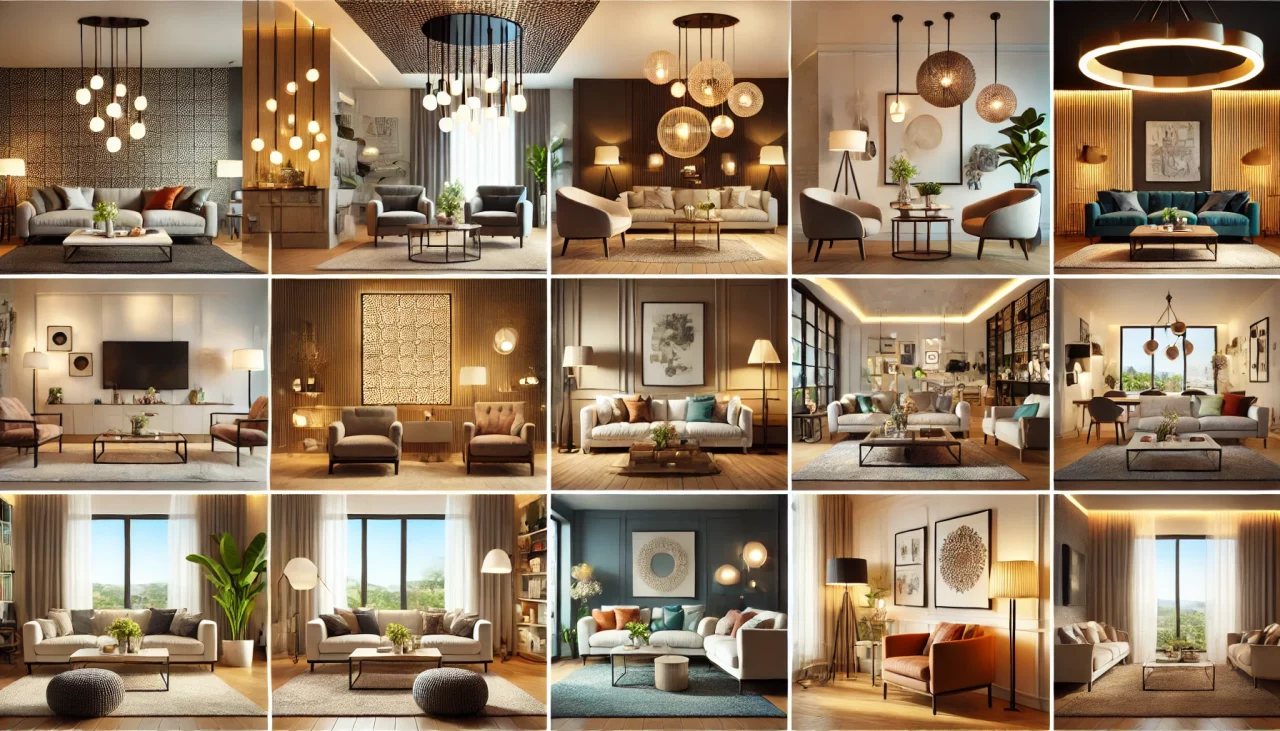
Living Room Lighting Design in Different Settings
The design you pick will fluctuate based on your setting.
- A contemporary home would benefit from modern, energy efficient recessed lighting or track lighting combined with task lighting from standing floor lamps.
- A traditional farmhouse would do better with antique ceiling lights designed for living room spaces combined with several standing lamps or table lamps.
What works best for you is based entirely on your design aesthetic, personal preferences, and the design elements of your living room.
Conclusion
When investing in living room lighting design, don’t be afraid to experiment with different lighting setups. Achieving the perfect modern living room light design comes down to having a mixture of ambient and task lighting, with things like flush mount or semi-flush mount options, especially in modern spaces, and, of course, the option of energy-efficient lights to bring down your costs.